Most residential asphalt shingle roof replacements in Springfield, Missouri, take approximately one to two days to complete. In fact, a fairly straightforward roof that’s under 3,000 square feet can often be completely torn off, replaced, and cleaned up in a single day.
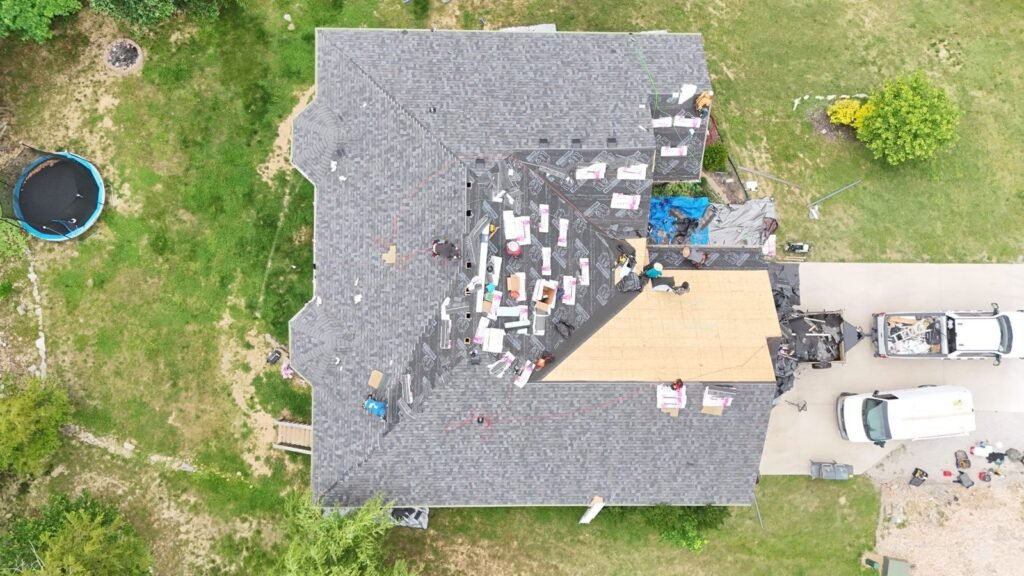
At Bold Roofing, our typical roofing crew consists of five to eight experienced installers who generally arrive around 7:00 AM and work until approximately 5:00 or 6:00 PM.
For a roof that’s under 4,000 square feet, isn’t extremely steep, and doesn’t have unusual complications, we can typically complete the entire project in about one to one and a half days.
Of course, there are exceptions.
Some roofs take longer because they’re steep, have multiple layers of old shingles, require extensive wood replacement, or have complicated features such as chimneys, skylights, and valleys.
And sometimes Mother Nature has other plans.
I’ve been in the roofing industry since 2017, and we’ve completed thousands of roofing projects throughout Southwest Missouri. I’ve seen jobs go exactly according to schedule, and I’ve seen situations where something completely unexpected changes the timeline.
So let me walk you through what you can realistically expect when replacing your roof, what can cause delays, and how to prepare so the process goes as smoothly as possible.
Can a Roof Really Be Replaced in One Day?
Absolutely. And it’s actually pretty common.
Let’s say you have a typical 2,500- to 3,000-square-foot asphalt shingle roof in Springfield, Ozark, Nixa, or Republic.
The roof has a moderate pitch, one existing layer of shingles, and no significant structural damage.
With a full crew of five to eight experienced installers, that’s the type of project we can often complete in one day.
And when I say one day, I mean the entire process:
- Protecting the property and preparing the work area
- Removing the existing shingles and underlayment
- Inspecting the exposed roof decking
- Replacing any damaged wood that needs attention
- Installing the new underlayment and waterproofing materials
- Installing drip edge, flashing, and ventilation components as needed
- Installing the new asphalt shingles and ridge caps
- Cleaning up roofing debris and performing magnetic nail cleanup
We’re not talking about showing up for a few hours, installing some shingles, and coming back three days later to finish the details.
We’re talking about a complete roof replacement.
Now, I don’t believe in promising every homeowner that their roof will absolutely be completed in one day.
Construction doesn’t work that way.
But if your roof is under 30 squares, isn’t particularly steep, has one existing layer, and the weather cooperates, completing it in a single day is a very realistic expectation.
What Time Do Roofing Crews Start and Finish?
Most of our residential roofing crews arrive at approximately 7:00 AM.
And yes, that means things are going to get noisy pretty early.
Once the crew starts removing shingles, you’ll hear tools, equipment, materials being moved, and people working on the roof.
It’s not exactly a peaceful morning.
On a typical one-day replacement, our crews may work until around 5:00 or 6:00 PM.
That’s approximately 10 to 11 hours on-site, depending on the job.
We try to make the most of the available daylight, especially during seasons when the days are shorter.
The goal is to complete the project efficiently while still making sure the installation is performed correctly.
I’d much rather have our crew spend an additional hour making sure everything is done properly than rush through the last few details just so we can say we finished by 5:00.
What Happens During a Typical One-Day Roof Replacement?
Here’s a general idea of how a straightforward residential roof replacement might progress.
7:00–8:00 AM: Arrival and Preparation
Our crew arrives, unloads equipment, prepares the work area, and begins protecting the property.
This may include positioning trailers or dumpsters, protecting landscaping, and organizing materials.
8:00–11:00 AM: Removing the Existing Roof
The crew removes the existing shingles and underlayment.
As sections of decking become exposed, we inspect the wood for damage or deterioration.
Any necessary decking replacement is addressed before the new roofing materials are installed.
11:00 AM–2:00 PM: Waterproofing and Shingle Installation
Once the roof deck is prepared, the crew installs the appropriate underlayment, ice and water barrier, flashing components, and other roofing materials.
Shingle installation begins as the roof is prepared.
2:00–5:00 PM: Completing the Roofing System
The crew continues installing shingles, ridge caps, ventilation components, and other necessary details.
The exact sequence depends on the roof design and installation requirements.
5:00–6:00 PM: Final Cleanup and Inspection
The crew collects debris, performs magnetic nail cleanup, checks the property, and completes the final inspection.
These times are only an illustration. On an actual job, different crew members may be working on multiple stages simultaneously, and the schedule can vary considerably.
But it gives you a general idea of what a full day of roofing looks like.
What Makes a Roof Replacement Take Two or More Days?
There are several things that can turn what appears to be a one-day project into a two-day project.
And sometimes those things aren’t obvious until we actually start working.
1. A Steep Roof Takes Longer
Roof pitch makes a big difference in installation time.
A relatively walkable 4/12 or 5/12 roof is much easier for an experienced crew to work on than a steep 10/12 or 12/12 roof.
On steep roofs, installers need additional fall-protection equipment and must work more carefully when moving materials and removing debris.
Everything takes longer.
It’s also physically demanding.
If you’ve ever spent an entire day working on a steep roof while wearing a harness and managing ropes, you know it’s a completely different experience from working on a relatively low-pitched roof.
So even if two roofs are exactly the same size, the steeper roof may take considerably longer.
2. Multiple Layers of Shingles Can Slow Everything Down
This is one of the more common surprises we encounter.
Sometimes a roof appears to have only one layer of shingles during the initial inspection.
But once we start tearing everything off, we discover an additional layer underneath.
Now the crew has twice as much material to remove in some areas, along with additional nails and underlayment.
That means more labor, more debris, and more disposal.
I’ve personally encountered roofs where a previous contractor removed older shingles only around the perimeter, making it appear that the entire roof had been torn off.
It wasn’t until we began the replacement that we discovered the additional layer covering most of the roof.
Obviously, something like that can change the schedule.
We can’t always predict what’s hidden underneath the existing roofing materials.
3. Extensive Wood Replacement Can Add Significant Time
Replacing a few damaged sheets of roof decking usually isn’t a huge deal.
That’s something we encounter fairly regularly.
But what if we remove the shingles and discover that the majority of the roof decking needs replacement?
Now we’re talking about a much bigger project.
The crew has to remove the deteriorated decking, inspect the underlying framing, and install new wood before proceeding with the roofing system.
If an entire home needs to be redecked, that can add substantial labor and potentially another day or more to the project.
And if there are structural issues involving rafters or trusses, the timeline can become even more complicated.
The good news is that a thorough initial inspection can often identify warning signs before installation begins.
But some conditions simply aren’t visible until the old roofing materials are removed.
4. Complicated Roof Designs Require More Labor
Not all roofs are simple rectangles.
Some homes have multiple valleys, hips, dormers, sidewalls, skylights, and chimneys.
Every one of those features requires additional attention.
A straightforward gable roof can often be installed relatively quickly because the crew is working across large, uninterrupted sections.
But a complicated roof with lots of intersections requires more measuring, cutting, flashing, and detailed waterproofing work.
And those details matter.
You don’t want your contractor rushing through a valley or roof-to-wall flashing just to save 30 minutes.
Those are exactly the areas where improper installation can create leaks later.
5. Chimney Flashing Can Be Surprisingly Time-Consuming
One example that comes to mind is a chimney with irregular stonework.
A standard chimney with relatively uniform masonry can be fairly straightforward to flash.
But when you’re dealing with uneven stone surfaces, complicated transitions, or deteriorated existing flashing, the work can become much more involved.
The crew may need additional time to properly integrate the flashing and counterflashing with the masonry and roofing system.
It’s detail-oriented work, and it’s not something I want rushed.
Sometimes one complicated chimney can add hours to a project.
6. Weather Is One of the Biggest Wild Cards
Here in Southwest Missouri, the weather can change pretty quickly.
We might start a project with a perfectly reasonable forecast, and a few hours later, rain is moving toward Springfield.
Obviously, we can’t just continue tearing off a roof while a storm is approaching.
We need to make sure the home is protected from water intrusion.
Extreme heat can also affect productivity and require additional breaks to protect the crew.
Cold temperatures can create installation challenges as well, particularly with certain roofing products and sealing requirements.
So if I tell a homeowner their roof should take one day, I also explain that weather can change that.
I’d rather delay the project or continue the next day than risk damaging someone’s home or compromising the installation.
Does a Metal Roof Take Longer to Install Than Asphalt Shingles?
Not necessarily.
A lot of homeowners assume that metal roofing automatically takes much longer than asphalt shingles.
But that isn’t always true.
Depending on the type of metal roofing system, roof design, and installation requirements, a metal roof can sometimes be installed in a timeframe similar to an asphalt shingle roof.
Of course, certain metal systems require more detailed fabrication, fastening, or flashing work and can take considerably longer.
The point is that you can’t determine the installation time based on the roofing material alone.
You have to look at the entire project.
How Long Does It Take to Replace a Tile Roof or Flat Roof?
This is where timelines can vary quite a bit.
Tile roofs and low-slope or flat roofing systems often require more time than a typical asphalt shingle replacement.
But I wouldn’t feel comfortable telling someone that every tile roof takes three days or every flat roof takes five days.
There are simply too many variables.
Tile Roof Replacement
Tile roofing can involve additional labor for removing and handling existing materials, preparing the roof, installing underlayment, and properly securing individual tiles.
Some tile systems are especially labor-intensive, and the condition of the underlying materials can significantly affect the timeline.
The specific tile product, roof pitch, accessibility, and roof design all matter.
Flat Roof Replacement
Flat roofing is even harder to generalize because there are so many different systems.
You might be dealing with TPO, EPDM, modified bitumen, or a roof coating system.
Each one has its own installation requirements.
Some systems require special substrates, adhesives, primers, or multiple application steps.
And certain products have specific temperature and humidity requirements.
For example, with some roof coatings, you may only have a two- or three-hour window during the day when conditions are appropriate for application.
Other products require drying or curing time before additional work can be performed.
So what might look like a simple one-day flat roof project could realistically take three to five days, depending on the materials and conditions.
That’s why we evaluate flat roofing projects individually rather than making blanket promises about installation time.
How Should You Prepare Your Home Before Roof Replacement Day?
This is something we take seriously at Bold Roofing because a little preparation can make the entire process much easier.
Before installation, we send our customers an email explaining what to expect and how to prepare.
Here are some of the most important things we ask homeowners to do.
Clear Your Driveway Before the Crew Arrives
This is a big one.
Our crews need room for vehicles, equipment, materials, and debris removal.
If you have cars in the driveway, we generally recommend moving them before the crew arrives.
And if you’re going to need a vehicle during the day, park it somewhere safely away from the work area, such as along the street where parking is permitted.
That way, you’re not trying to move your vehicle while shingles, nails, and other materials are being removed from the roof.
It also gives our crew the access they need to work efficiently.
Make Arrangements for Your Pets
Roof replacement is loud.
There’s really no way around that.
If you’ve got dogs or other animals that are sensitive to noise, you may want to make arrangements for them during installation.
Some homeowners keep their pets in a quieter area of the house.
Others take them to a family member’s home or a pet boarding facility for the day.
Whatever works best for your situation.
We just want your pets to be safe and as comfortable as possible.
Unlock Gates and Provide Access to the Property
If you’ve got a locked gate that prevents access to your backyard, please make sure it’s unlocked before the crew arrives.
We may need access to different sides of the home for debris removal, equipment, inspections, and cleanup.
Having full access helps us avoid unnecessary delays.
Make an Outdoor Electrical Outlet Available
Some of our equipment may require electricity.
We generally ask homeowners to make an accessible outdoor outlet available when possible.
If an extension cord is needed, it should be appropriately rated for outdoor use and the equipment being operated.
That helps us keep the work moving without having to interrupt the homeowner.
Stay Away From the Active Work Areas
This is probably the most important safety recommendation.
When we’re tearing off a roof, there’s going to be debris.
Old shingles, nails, underlayment, and other materials are being removed and transported around the property.
Even with precautions in place, a roofing project is an active construction site.
We don’t want homeowners or children walking around the house during tear-off and accidentally stepping on a nail or being struck by falling debris.
If you need to enter or leave the home during installation, coordinate with the project manager so we can help you do that safely.
Expect Noise Throughout the Day
I always tell homeowners that we’re going to show up early, and we’re going to start making noise.
Don’t be alarmed.
That’s normal.
There will be hammering, equipment running, people moving across the roof, and debris being removed.
If you work from home and spend your day on video calls, you might want to consider working somewhere else that day.
And if you’ve got a baby who needs to nap or somebody in the household who is especially sensitive to noise, it’s worth planning ahead.
The good news is that for many homeowners, it’s only one day of disruption.
Do You Need to Be Home While Your Roof Is Being Replaced?
In most cases, no.
And honestly, a lot of our customers prefer not to be.
They’re busy working, running businesses, taking care of their families, or doing whatever else they normally do during the day.
We don’t expect them to stand outside supervising the roofing crew.
That’s our responsibility.
At Bold Roofing, we have project supervision during installation, and we document the work with photographs throughout the process.
If we discover something unexpected that requires a homeowner’s decision, we’ll reach out.
Otherwise, our goal is to let them go about their day without having to worry about every little detail.
We’ve even completed roofing projects while homeowners were out of town.
As long as we’ve coordinated access and communication beforehand, that can work perfectly well.
What Happens If Your One-Day Roof Replacement Takes Two Days?
This is something I like to be upfront about.
If I inspect your roof and believe we can finish it in one day, that’s what I’m going to tell you.
But I’m also going to explain that it could carry into the following day.
Maybe the weather changes.
Maybe we discover additional layers of shingles.
Maybe there’s more wood replacement than expected.
Or maybe the project simply takes a little longer than anticipated.
You know the old saying about Murphy’s Law?
Well, sometimes Murphy shows up during a construction project.
And that’s okay.
We’ll deal with it.
The important thing is that we communicate what’s happening, keep the home protected, and continue working toward completion.
What I don’t want is a crew rushing through important installation details because everybody is worried about finishing before sunset.
Getting your roof installed correctly is more important than getting it installed quickly.
Ideally, we accomplish both.
But if I have to choose between finishing at 6:00 PM with questionable workmanship or coming back the next morning to finish everything properly, I’m choosing the second option.
Every time.
Is a One-Day Roof Replacement Better Than a Two-Day Replacement?
Not necessarily.
I think homeowners sometimes get too focused on how fast a contractor says they can replace a roof.
And I understand why.
Nobody wants construction going on around their home for a week.
But a one-day roof replacement isn’t automatically better than a two-day roof replacement.
A well-organized, experienced crew can absolutely complete a quality roof replacement in one day.
On the other hand, a complicated roof that requires two days of careful work may be a much better result than trying to force everything into one day.
The things I would pay attention to are:
- Is the contractor using quality materials?
- Are they following the manufacturer’s installation instructions?
- Are they properly addressing flashing and waterproofing details?
- Is the roof decking being inspected and repaired where necessary?
- Is somebody supervising the work?
- Is the property being protected?
- Are they performing a thorough cleanup?
- Are they communicating clearly about the schedule?
Those things matter a lot more than whether the project takes 10 hours or 15 hours.
How Long Should You Plan for Your Roof Replacement in Southwest Missouri?
If you’re replacing a fairly typical asphalt shingle roof in Springfield, Branson, Nixa, Ozark, Republic, Hollister, Branson West, Kimberling City, or the surrounding area, here’s what I would generally tell you.
Plan on one to two days.
If your roof is under 30 squares, has one layer of shingles, isn’t particularly steep, and doesn’t have unusual complications, there’s a very good chance we’ll complete it in one day.
If it’s between 30 and 40 squares, a day to a day and a half is often realistic, depending on the roof design.
If your roof is extremely steep, has multiple layers, requires extensive decking replacement, or has complicated flashing details, it may take longer.
And if we’re installing tile or certain flat roofing systems, the timeline may be several days depending on the materials and installation requirements.
The best way to get an accurate estimate is to have a contractor evaluate the actual roof rather than relying on a generic timeframe.
Need a Roof Replacement in Springfield, MO? We’ll Make the Process Simple.
At Bold Roofing, we understand that having your roof replaced can be a disruption.
Nobody looks forward to waking up at 7:00 AM to the sound of shingles being torn off their house.
But the good news is that for most residential asphalt shingle replacements, the disruption is relatively short.
Our goal is to show up when we say we will, protect your property, work efficiently, keep you informed, and complete the installation correctly.
We use experienced roofing crews, provide project supervision, document our work, and take cleanup seriously.
And if something unexpected happens, we’ll communicate with you rather than leaving you wondering what’s going on.
We want you to be able to go to work, take care of your family, or even leave town while we handle the project.
Because at the end of the day, you’re hiring us to take care of your roof—not to give you another full-time job managing a construction project.
Most roofs take one or two days. Our goal is to make those days as easy on you as possible.
If you’re considering replacing your roof in Springfield or anywhere throughout Southwest Missouri, contact Bold Roofing to schedule an inspection and get a realistic estimate of both the cost and installation timeline.