If you’re replacing your roof in Springfield, Republic, Branson, or anywhere in Southwest Missouri, you’re probably wondering whether you should install architectural asphalt shingles, impact-resistant shingles, or a metal roof.
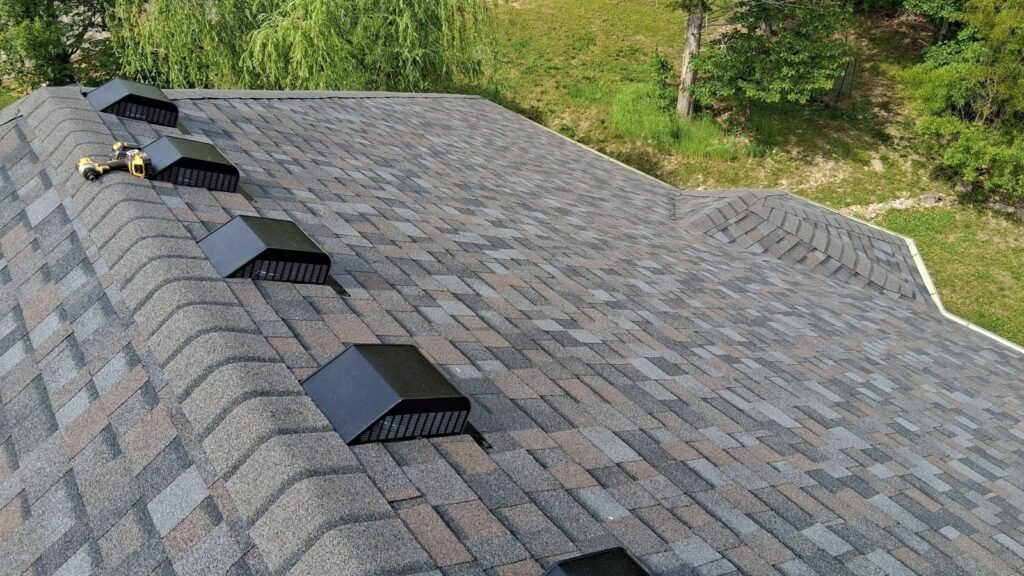
My recommendation for most homeowners in Southwest Missouri is a quality architectural asphalt shingle. And if your budget allows, upgrading to a Class 4 impact-resistant shingle may be worth considering.
Now, you might be surprised to hear that from a roofing contractor who installs both shingles and metal roofing.
After all, metal roofing can last significantly longer than asphalt shingles. So why wouldn’t I automatically recommend metal?
Well, there’s something most homeowners don’t consider when comparing roofing materials, and it’s a pretty big deal here in Missouri.
Your homeowners insurance policy can have just as much influence on which roofing material makes financial sense as the roofing material itself.
I’ve owned a roofing company since 2017, and before that, I spent years working as an insurance agent and adjuster. I’ve handled thousands of insurance claims and been involved in thousands of roofing projects.
And after seeing how insurance companies handle hail damage, wind damage, cosmetic damage exclusions, and roof replacements, I’ve developed a pretty strong opinion about which materials offer the best value in our region.
Let me explain.
1. Why Architectural Asphalt Shingles Are My First Choice for Most Missouri Homes
Here in Springfield, Republic, Nixa, Ozark, Branson, and the surrounding communities, we experience plenty of severe weather.
Hailstorms, high winds, tornadoes, extreme summer heat, freezing temperatures, ice, and snow are all part of living in Southwest Missouri.
And unfortunately, there’s no roofing material that’s completely immune to those conditions.
That’s one reason I generally recommend architectural asphalt shingles.
They’re affordable compared to many alternatives, they’re widely available, they’re relatively straightforward to install, and they’re usually much easier to repair or replace when storm damage occurs.
But there’s another reason I like them.
Architectural Shingles and Homeowners Insurance Coverage
Most homeowners don’t spend much time reading their insurance policy until they actually need to file a claim.
And I understand that.
Insurance policies aren’t exactly exciting reading material.
But something I’ve noticed over the years is that many insurance companies have become increasingly restrictive about certain types of roof damage.
One particularly important example involves metal roofing.
Many homeowners insurance policies include cosmetic damage exclusions for metal roofs.
That means a hailstorm could leave your metal roof covered in visible dents, but if the damage doesn’t affect the roof’s ability to function, the insurance company may not pay to replace it.
Now imagine spending two or three times as much money installing a beautiful metal roof, only to have a hailstorm leave it looking like a golf ball.
The roof might still be watertight.
But it certainly doesn’t look the way it did before the storm.
And if your policy excludes cosmetic damage, you may be responsible for paying to replace those dented panels yourself.
That’s a pretty expensive situation.
With asphalt shingles, hail damage is evaluated differently. Hail impacts that damage the shingle’s protective components or affect its performance may qualify as covered damage, depending on the insurance policy.
That doesn’t mean every visible mark on an asphalt shingle qualifies for replacement. It doesn’t.
But in my experience, asphalt shingles generally offer homeowners a more practical combination of installation cost, repairability, and potential storm damage coverage.
That’s why I believe architectural shingles are usually the best bang for your buck in Southwest Missouri.
2. Are Class 4 Impact-Resistant Shingles Worth the Extra Money?
In many cases, I think they are.
But I also think homeowners need to understand what they’re actually purchasing.
A Class 4 impact-resistant shingle isn’t indestructible.
It doesn’t mean hail will never damage your roof again.
It simply means the product has passed a higher level of standardized impact-resistance testing than lower-rated products.
And that can be valuable in a region like Springfield, Missouri, where hailstorms are a regular concern.
What’s the Difference Between Class 3 and Class 4 Shingles?
Class 3 and Class 4 are impact-resistance classifications commonly associated with UL 2218 testing.
Class 4 represents a higher tested impact-resistance level.
Some Class 4 shingles achieve that performance using thicker or reinforced materials.
Others use modified asphalt technologies, including SBS polymers, which can improve flexibility and impact resistance.
There are several different approaches manufacturers use, and not every Class 4 shingle is constructed the same way.
One thing I want to emphasize is that a Class 4 rating is based on a standardized laboratory test.
It isn’t a guarantee that the shingle will survive every real-world hailstorm.
Hailstones vary in size, shape, density, hardness, and impact velocity.
I’ve seen storms where the hail was so severe that just about any roofing material could sustain damage.
But I’ve also seen situations where upgrading to a Class 4 shingle made a noticeable difference.
How Much More Do Class 4 Shingles Cost in Springfield, MO?
In our local market, upgrading from a Class 3 architectural shingle to a Class 4 impact-resistant shingle will often add approximately $50 to $100 per roofing square.
A roofing square is 100 square feet of roof area.
I’d say around $75 per square is a reasonable general planning estimate, although actual costs depend on the manufacturer, product, and supplier pricing.
For example, let’s say your roof is 30 squares, or approximately 3,000 square feet.
- At $50 more per square, the upgrade would cost approximately $1,500.
- At $75 more per square, the upgrade would cost approximately $2,250.
- At $100 more per square, the upgrade would cost approximately $3,000.
That’s certainly not pocket change.
But when you’re already investing in a complete roof replacement, it may be worth considering whether the additional protection makes financial sense.
A Real Springfield Home Where Class 4 Shingles Made a Difference
We completed a roof replacement on a home in southeast Springfield, Missouri, that had sustained hail damage.
The homeowner previously had a Class 3 architectural shingle roof.
The insurance company approved the storm damage claim, and the homeowner decided to pay the additional cost to upgrade to Class 4 impact-resistant shingles.
Later, another significant hailstorm moved through the area.
We evaluated the roof afterward, and the Class 4 shingles had not sustained identifiable hail damage during that storm.
That’s exactly the kind of outcome you’re hoping for when you spend additional money on an impact-resistant product.
Now, I’m not saying that would happen every time.
A larger, harder, or more irregularly shaped hailstone could absolutely damage that same roof in another storm.
But in this particular situation, the homeowner’s upgrade appeared to pay off.
They avoided another damaged roof and potentially avoided the inconvenience and expense of another insurance claim.
And that’s how I think homeowners should evaluate Class 4 shingles.
You’re not necessarily purchasing a roof that will never be damaged. You’re purchasing a roof that may withstand certain storms that could damage a less impact-resistant product.
Can Class 4 Shingles Lower Your Homeowners Insurance Premium?
Possibly.
Some insurance companies offer premium discounts for qualifying impact-resistant roofing products.
The amount varies by insurance carrier, policy, location, and roofing material.
Not every Class 4 product qualifies for every insurer’s discount program.
And some policies include special cosmetic damage provisions or other limitations related to impact-resistant roofs.
So before choosing a shingle solely because of a potential insurance discount, I recommend contacting your insurance agent.
Ask what discounts are available, which roofing products qualify, and whether any additional policy endorsements or exclusions apply.
If the upgrade helps you avoid a future deductible and qualifies you for an annual premium discount, it could become a pretty attractive investment.
3. Is Metal Roofing Better Than Asphalt Shingles in Springfield, Missouri?
Metal roofing can be an excellent product.
But I don’t believe it’s automatically the best choice for every homeowner.
And frankly, I think there are a lot of misconceptions about metal roofs.
Some homeowners believe that once they install a metal roof, they’ll never need to worry about their roof again.
No maintenance.
No storm damage.
No repairs.
No problems for 50 years.
That’s simply not how it works.
Metal roofing can be extremely durable, but it isn’t indestructible.
Large hail can dent metal panels.
Severe wind can damage or displace improperly secured roofing components.
And depending on the system, fasteners, sealants, flashing, and closure materials may require maintenance over time.
The Biggest Concern I Have With Metal Roofing: Cosmetic Hail Damage
This is probably the number one reason I encourage homeowners to carefully review their insurance policies before purchasing a metal roof.
Many insurance companies offer policies that exclude cosmetic damage to metal roofing.
Let’s say you install a beautiful standing-seam metal roof on your home in Republic, Missouri.
You spend considerably more than you would have spent on architectural shingles.
Two years later, a hailstorm comes through and leaves dents across several roof slopes.
The panels are still functioning.
There’s no water entering the house.
But the roof looks terrible.
If your policy excludes cosmetic damage, your insurance company may determine that those dents aren’t covered.
That doesn’t mean the insurance company can deny every metal roof claim.
If hail or wind causes covered functional damage, such as punctures, compromised seams, or other damage affecting the roof’s performance, coverage may still apply.
The exact policy language matters.
But if appearance is important to you, cosmetic damage exclusions are something you absolutely need to understand before investing in metal roofing.
I can’t tell you how many homeowners have reconsidered metal after I explained that possibility.
They simply hadn’t thought about it.
Metal Roofing Can Cost Two to Three Times as Much as Shingles
In many residential situations around Springfield, Republic, and Branson, a premium standing-seam metal roof can cost approximately two to three times as much as an architectural asphalt shingle roof.
That isn’t a universal pricing rule.
Metal roof pricing varies substantially depending on the panel system, metal type, roof complexity, underlayment, flashing requirements, and installation methods.
Exposed-fastener metal roofing can be considerably less expensive than standing seam.
But premium concealed-fastener systems often require a significantly larger investment.
And that’s why I encourage homeowners to consider how long they plan to own the property.
If you’re planning to sell in five or ten years, spending substantially more on metal may not make financial sense.
But if this is your forever home, that’s a different conversation.
4. Exposed-Fastener Metal vs. Standing-Seam Metal Roofing
Not all metal roofs are created equal.
There are two common types of residential metal roofing systems I want homeowners to understand.
Exposed-Fastener Metal Roofing
Exposed-fastener systems use screws that penetrate through the metal panels and secure them to the underlying roof structure.
These systems are commonly used on homes, barns, workshops, garages, and other buildings throughout Southwest Missouri.
They can be relatively affordable compared to standing-seam systems.
But they also have a maintenance consideration that homeowners sometimes overlook.
Those exposed fasteners typically use sealing washers to help prevent water intrusion.
Over time, temperature changes, ultraviolet exposure, panel movement, and general weathering can affect the fasteners and their seals.
Depending on the system and its condition, fasteners may eventually need to be tightened, replaced, or otherwise serviced.
In our area, I often encourage homeowners to start paying particularly close attention to those fasteners as the roof approaches 10 to 15 years of age.
That doesn’t mean every exposed-fastener roof requires complete screw replacement at exactly 10 or 15 years.
But it does mean the system shouldn’t be treated as maintenance-free.
When you have hundreds or thousands of penetrations through the metal panels, proper fastener installation and maintenance are extremely important.
Closure strips, sealants, and other accessories can also deteriorate or become damaged by animals or weather exposure.
So if somebody tells me they want an exposed-fastener metal roof because they never want to maintain their roof again, I explain those things before they make their decision.
Standing-Seam Metal Roofing
Standing-seam metal roofing is a different system.
The panels are generally secured using concealed clips or fastening methods, depending on the specific design.
That eliminates the large number of exposed panel fasteners associated with traditional screw-down metal roofing.
And from a long-term maintenance standpoint, that’s a significant advantage.
A properly designed and installed standing-seam metal roof can provide decades of service.
Under favorable conditions, certain systems can last 40 to 50 years or longer.
But that depends on the metal, coating, roof design, installation quality, environment, and ongoing maintenance.
If a homeowner tells me they’re building a house that they plan to live in for the rest of their life and eventually pass down to their children, I think standing-seam metal deserves serious consideration.
In that situation, the longer potential service life may justify the higher upfront cost.
But I would still encourage them to review their homeowners insurance policy, particularly any cosmetic hail damage exclusions.
5. Will You Hear Rain on a Metal Roof?
This one always makes me smile because I hear it pretty often.
Somebody tells me, “I’ve always wanted a metal roof because I love the sound of rain hitting a tin roof.”
And I understand that.
There’s something nostalgic about that sound.
But here’s what I explain to them.
If you’re installing a metal roof on a modern residential home with solid OSB or plywood decking, underlayment, insulation, an attic assembly, and drywall ceilings, you probably aren’t going to hear rain the way you’re imagining.
All those building materials help dampen the sound.
Now, if you’re sitting inside an old barn with exposed rafters, minimal insulation, and metal panels installed over spaced framing, that’s a different story.
You’re probably going to hear the rain pretty clearly.
But on a typical modern home, the difference may be much less noticeable than people expect.
So if the sound of rain is your primary reason for wanting a metal roof, I’d encourage you to experience one on a similarly constructed home before spending the additional money.
6. What’s the Best Roofing Material for Homes Near Branson and Table Rock Lake?
This is where the conversation gets a little more interesting.
Homes around Branson, Hollister, Branson West, Kimberling City, and Table Rock Lake often have different considerations than a typical subdivision home in Springfield or Republic.
For one thing, many lake homes are built on steep hillsides or elevated lots.
Some are two or three stories tall on the lake-facing side, even if they appear to be only one or two stories from the driveway.
That can create different wind-exposure conditions.
Wind Exposure Around Table Rock Lake
Wind conditions can be particularly challenging for certain homes around the lake.
Properties located on exposed ridges, steep slopes, or elevated terrain may experience stronger wind exposure than nearby sheltered properties.
The actual wind loads depend on the home’s location, height, terrain, surrounding obstructions, and building design.
It’s not as simple as saying every home above 30 feet experiences a particular increase in wind speed.
But I’ve certainly seen how exposed lake properties can experience significant wind-related roofing damage.
That’s why proper installation becomes especially important.
Whether you’re installing shingles or metal, the roofing system needs to be appropriate for the building and installed according to the manufacturer’s requirements and applicable building codes.
Curb Appeal and Resale Value Matter More Than Some Homeowners Realize
Another thing I’ve noticed around Table Rock Lake is that resale value and curb appeal can be particularly important.
Some lake homes are second homes or vacation properties.
Others are properties that owners eventually plan to sell when their circumstances change.
And a roof can have a significant impact on how the property looks.
A beautiful architectural shingle roof can complement a lake home extremely well.
So can standing-seam metal.
But the important question is whether the additional cost of metal will actually translate into additional resale value.
And I don’t think homeowners should automatically assume it will.
7. Does a Metal Roof Increase Your Home’s Resale Value?
This is another area where I think homeowners need realistic expectations.
Let’s say you have two nearly identical homes in Republic, Missouri.
Both have relatively new roofs in good condition.
One has architectural asphalt shingles.
The other has a standing-seam metal roof that cost considerably more.
Does that automatically mean the metal-roofed home is worth $15,000 or $20,000 more?
No.
Real estate appraisals generally depend on market evidence, comparable sales, property condition, and other factors.
An appraiser doesn’t automatically add the full cost of a metal roof to the home’s value simply because it was more expensive to install.
And in my experience, many buyers are primarily concerned with whether the roof is in good condition and whether they’re likely to face a major replacement expense soon.
A premium metal roof may be a desirable feature, especially on certain high-end homes.
But that doesn’t guarantee you’ll recover the extra investment when you sell.
Some markets and property types may support a premium. Others may not.
That’s why I generally tell homeowners that if they expect to sell their house within the next 10 or 15 years, architectural shingles are often the more financially practical option.
If they plan to own the property for 20, 30, or even 40 years, the potential long-term value of standing-seam metal becomes more compelling.
I wouldn’t install a metal roof solely because I expected to recover the additional cost when selling the home.
8. Which Roofing Material Requires the Least Maintenance?
This depends on the type of roofing system.
But for most homeowners who want something simple, affordable, and easy to service, I still like architectural asphalt shingles.
They’re widely available.
Most qualified roofing contractors are familiar with them.
Replacement materials are generally easy to obtain.
And when minor damage occurs, repairs are often relatively straightforward, assuming the shingles remain flexible and compatible replacement materials are available.
Standing-seam metal can also offer relatively low maintenance requirements over a long period, particularly because it doesn’t rely on exposed panel fasteners.
Exposed-fastener metal roofing, on the other hand, may require more attention to fasteners and sealing components.
But there’s something even more important than the material itself.
Installation Quality Matters More Than Most Homeowners Think
I could install one of the highest-rated shingles on the market.
It could have excellent independent testing results, strong wind ratings, and a premium manufacturer warranty.
But if the installation crew doesn’t follow the manufacturer’s instructions, none of that matters very much.
If they don’t use enough nails, you’ve got a problem.
If they install the flashing incorrectly, you’ve got a problem.
If the roof decking is deteriorated and won’t properly hold fasteners, you’ve got a problem.
If they construct the valleys incorrectly or ignore important installation details, you’ve got a problem.
I’ve seen expensive roofing products fail prematurely because of poor workmanship.
And I’ve seen ordinary architectural shingles perform extremely well because they were installed correctly.
When comparing reputable Class 3 architectural shingle products, I believe proper installation is often more important than small differences in marketing claims or product ratings.
A well-installed roofing system should provide many years of reliable service under normal conditions.
Of course, a severe hailstorm or wind event can damage even a properly installed roof.
But that’s a weather event, not necessarily an installation failure.
At Bold Roofing, we place a lot of emphasis on the installation details because those are the things that help determine whether a roof performs the way it’s supposed to.
9. How Long Do Asphalt Shingle and Metal Roofs Last in Southwest Missouri?
You’ll see manufacturers advertise asphalt shingles with limited lifetime warranties.
And you’ll hear some people say metal roofs can last 50 years or longer.
But there’s an important difference between a manufacturer’s warranty and the actual service life you should reasonably expect in your location.
Here in Southwest Missouri, our roofs experience intense sunlight, temperature changes, wind, hail, and occasional ice and snow.
Those conditions can shorten the useful life of a roofing system.
For planning purposes, here’s how I generally look at it.
Architectural Asphalt Shingles
In our region, getting approximately 20 years out of an asphalt shingle roof can be a very good result.
Some roofs will last longer.
Others will sustain storm damage or experience deterioration much sooner.
Roof orientation, ventilation, installation quality, material selection, and weather exposure all make a difference.
Class 4 Impact-Resistant Asphalt Shingles
These may offer improved resistance to certain hail impacts compared with lower-rated products.
However, I wouldn’t automatically assume a Class 4 shingle will last a specific number of years longer than a standard architectural shingle.
Its biggest advantage may be helping the homeowner avoid damage during certain storms.
Exposed-Fastener Metal Roofing
These systems can provide decades of service when properly installed and maintained.
But fasteners, sealing washers, closures, and other components may need periodic inspection or replacement.
Standing-Seam Metal Roofing
A quality standing-seam metal roof can potentially last 40 to 50 years or longer under favorable conditions.
For homeowners planning to remain in their property for several decades, that can be a major benefit.
But remember, none of these materials are immune to severe weather.
And the actual life of any roofing system depends on more than the product itself.
10. My Recommendation: Which Roof Would I Choose for My Own Home in Springfield, Missouri?
If I were replacing the roof on a typical residential home in Springfield, Republic, or Nixa, I’d probably choose a high-quality architectural asphalt shingle.
And depending on the additional cost, I’d strongly consider upgrading to a Class 4 impact-resistant product.
Here’s why.
It’s a practical roofing system.
It looks good on most homes.
It’s widely available.
It’s relatively easy to repair and maintain.
And in our storm-prone region, I believe it generally provides the best balance of upfront cost, performance, and insurance considerations.
Now, if I were building my forever home near Branson or Table Rock Lake, and I knew I wanted to stay there for 30 or 40 years, I might seriously consider a premium standing-seam metal roof.
But I would go into that decision understanding the higher upfront cost, possible cosmetic hail damage exclusions, and the fact that I might not recover the extra investment if I sold the house sooner than expected.
That’s the distinction I want homeowners to understand.
The most expensive roof isn’t automatically the best roof. The best roof is the one that makes the most sense for your home, your budget, your insurance coverage, and how long you plan to own the property.
Frequently Asked Questions About Roofing Materials in Springfield, Missouri
What Is the Best Roofing Material for Missouri Weather?
For most residential homes in Southwest Missouri, I recommend architectural asphalt shingles because they offer a practical balance of affordability, durability, repairability, and appearance. Class 4 impact-resistant shingles may be worth the additional investment in areas that experience frequent hailstorms.
Are Metal Roofs Better Than Shingles for Hail?
Metal roofs can resist certain types of hail damage, but they can also sustain cosmetic dents or functional damage during severe storms. Class 4 impact-resistant shingles are another option worth considering. No roofing material is completely hail-proof.
How Much More Does a Metal Roof Cost Than Shingles in Springfield, MO?
Premium standing-seam metal roofing may cost approximately two to three times as much as architectural asphalt shingles, depending on the project. Exposed-fastener metal roofing is generally less expensive than standing seam. Actual pricing depends on roof size, complexity, materials, and installation requirements.
Are Class 4 Shingles Worth It in Springfield, Republic, or Branson?
They can be. Class 4 shingles may withstand certain hail impacts that could damage lower-rated products. The upgrade may also help some homeowners qualify for insurance discounts, depending on their insurer and policy.
Do Insurance Companies Cover Hail Damage to Metal Roofs?
It depends on the policy and the type of damage. Many policies exclude cosmetic hail damage to metal roofing, but covered functional damage may still qualify for payment. Homeowners should review their policy’s specific language.
Is Standing-Seam Metal Better Than Exposed-Fastener Metal?
For homeowners prioritizing long-term service life and reduced fastener maintenance, standing-seam metal is often the stronger choice. It generally costs more upfront but avoids the numerous exposed panel fasteners used in traditional screw-down metal roofing.
Will a Metal Roof Increase My Home’s Value in Branson, Missouri?
It may improve curb appeal and appeal to certain buyers, but the additional installation cost isn’t automatically recovered through resale value. The actual value depends on local comparable sales, buyer preferences, property type, and roof condition.
How Long Should a Roof Last in Springfield, Missouri?
A well-installed asphalt shingle roof may provide around 20 years of service in Southwest Missouri, although actual life varies significantly with weather exposure and maintenance. Quality standing-seam metal roofing can potentially last several decades longer under favorable conditions.
Final Thoughts: Don’t Choose a Roofing Material Based on Marketing Alone
If you’re getting ready to replace your roof in Springfield, Republic, Branson, or anywhere in Southwest Missouri, I’d encourage you to look beyond the advertisements and manufacturer claims.
Don’t automatically assume the most expensive product is the best.
Don’t assume a metal roof will never need maintenance.
And don’t assume an impact-resistant shingle is completely hail-proof.
Instead, consider how long you plan to own your home, what your insurance policy actually covers, and what makes the most financial sense.
In my experience, architectural asphalt shingles are the best overall value for most homeowners in our area.
And if you want some additional protection against hail, a Class 4 impact-resistant shingle may be a worthwhile upgrade.
But if you’re building a home you plan to keep in the family for generations, a quality standing-seam metal roof might be worth the additional investment.
There’s no one-size-fits-all answer.
And that’s exactly why I believe homeowners deserve an honest explanation of their options rather than being pushed toward whichever roofing material happens to generate the biggest sale.
Need Help Choosing the Best Roof for Your Home in Springfield, Republic, or Branson?
At Bold Roofing, we help homeowners throughout Southwest Missouri choose roofing systems that make sense for their homes, budgets, and long-term plans.
We serve Springfield, Republic, Nixa, Ozark, Highlandville, Branson, Hollister, Branson West, Kimberling City, Lampe, and surrounding communities.
Whether you’re considering traditional architectural shingles, Class 4 impact-resistant shingles, exposed-fastener metal, or premium standing-seam metal, we’d be happy to explain the differences and provide a detailed estimate.
And because of my background as an insurance agent and adjuster, we can also help you understand the roofing-related considerations that may affect future storm damage claims.
We’ll explain your options, answer your questions, and help you make an informed decision without unnecessary pressure.
Contact Bold Roofing today to schedule a roof inspection or request a roof replacement estimate.
Out with the OLD roof. In with the BOLD roof!