A new asphalt shingle roof in Springfield, Missouri, typically costs between $10,000 and $20,000, with an average of $15,301 based on the last 118 roofing projects we reviewed at Bold Roofing.
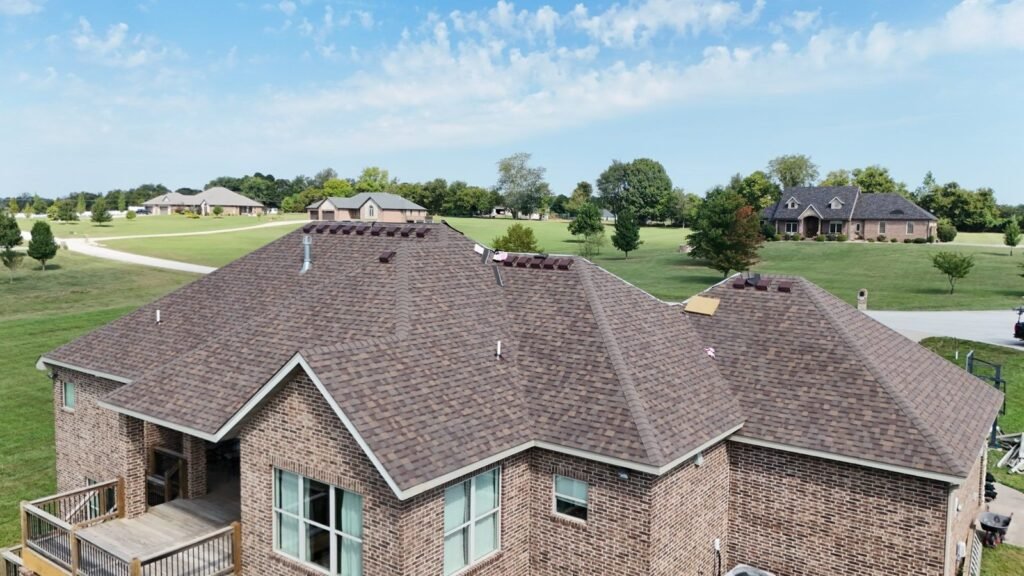
For a fairly straightforward roof replacement, you’re looking at approximately $4.50 per square foot of roof surface, or $450 per roofing square. A roofing square is simply 100 square feet.
So, if you have a 30-square roof (3,000 square feet of actual roof surface), you might expect to pay around $13,500 for a standard asphalt shingle replacement.
But here’s where things get interesting.
That exact same 30-square roof could cost $13,200 on a relatively walkable 4/12 pitch, or $16,500 or more on a steep 12/12 pitch. Same amount of roofing material. Thousands of dollars in difference.
And that’s before we start talking about additional layers of shingles, skylights, wood replacement, or other complications.
I’ve been in the roofing business since 2017, and before that, I worked as an insurance agent and adjuster. Between those two industries, I’ve seen roofing projects from just about every angle.
I want to walk you through what actually determines the price of a new roof in Springfield and Southwest Missouri, what homeowners should watch out for, and a few real situations we’ve encountered that might help you avoid some expensive surprises.
What Does a Typical Roof Replacement Cost in Springfield, Missouri?
Let’s start with actual numbers rather than the national averages you see on a lot of roofing websites.
We recently reviewed our last 118 projects at Bold Roofing, and the average project price was $15,301.
For a typical residential asphalt shingle roof replacement, I would generally tell a Springfield homeowner to expect somewhere between $10,000 and $20,000.
Of course, there are smaller roofs that cost less and larger or more complicated roofs that cost considerably more.
Here are some rough examples using $450 per roofing square:
- 20-square roof (2,000 square feet): Approximately $9,000
- 25-square roof (2,500 square feet): Approximately $11,250
- 30-square roof (3,000 square feet): Approximately $13,500
- 35-square roof (3,500 square feet): Approximately $15,750
- 40-square roof (4,000 square feet): Approximately $18,000
- 45-square roof (4,500 square feet): Approximately $20,250
These are starting-point estimates for asphalt composition shingles, not guaranteed quotes. The actual price depends on your roof’s design, pitch, accessibility, and the work required.
Also, when I say a 30-square roof, I’m talking about the actual roof surface—not the square footage of the house.
A 2,000-square-foot home can easily have substantially more than 2,000 square feet of roofing, especially if it’s a single-story home with a complicated roof design.
Why Can Two Roofs the Same Size Cost Thousands of Dollars Apart?
This is probably one of the most misunderstood things about roofing prices.
People understandably assume that if their neighbor has a 3,000-square-foot roof and they have a 3,000-square-foot roof, the prices should be pretty similar.
But that’s not always the case.
There are several things that can change the cost significantly, and some of them have very little to do with the price of shingles.
Roof Pitch Is One of the Biggest Factors
If I had to pick one thing that can make a really significant difference in roofing prices, it would be the pitch of the roof.
Pitch is simply how steep your roof is.
A 4/12 or 5/12 roof is relatively walkable for an experienced roofing crew under the right conditions.
A 12/12 roof is a completely different story.
Let’s say we have two houses, and both have 30 squares of roofing. They both have one layer of existing shingles, similar accessibility, and we’re installing the same products.
The only real difference is that one roof is a 4/12 pitch and the other is a 12/12 pitch.
Here’s how that could affect the price:
- 30-square roof at a 4/12 pitch: $440 per square, or $13,200
- 30-square roof at a 12/12 pitch: $550 per square, or $16,500
That’s a $3,300 difference, or approximately 25% more, for the same amount of roofing material.
And there’s a legitimate reason for that.
When our crews are working on a very steep roof, they’re using additional fall-protection equipment, ropes, and harnesses. Everything takes longer. It’s more physically demanding, and we have to take additional precautions to protect the crew and the property.
Materials and debris can slide off a steep roof much more easily, so the entire process requires more attention.
You’re not necessarily paying for better shingles. You’re paying for the additional labor, difficulty, and safety requirements involved in completing the job correctly.
Additional Layers of Shingles Can Get Expensive
Another thing that can really affect your roof replacement cost is how many layers of shingles are already on your home.
Removing one layer is fairly straightforward.
But if there’s a second or third layer underneath, now we’re talking about significantly more labor and disposal.
In our experience, removing an additional layer might add approximately 50 per square in labor-related costs. More extensive multilayer removal can add 70 per square or more, depending on the circumstances.
And sometimes those extra layers aren’t visible during the initial inspection.
Let me give you a real example.
The $3,000 Surprise We Found Under a Customer’s Roof
We recently replaced a roof for a homeowner who had an insurance claim due to hail damage.
During the initial inspection, we lifted the shingles along the eaves to check how many layers were present.
Everything looked normal.
The insurance adjuster did essentially the same thing and came to the same conclusion.
But once we started tearing off the roof, we discovered something pretty unusual.
The previous roofer had removed the older shingles only about one or two feet up from the perimeter of the roof.
Everywhere else, the original shingles were still underneath.
So when somebody lifted the edge to check whether the old shingles had been removed, it appeared they had.
But across the majority of the roof, there were actually two layers.
Now, I can’t tell you exactly why the previous roofer did that. But removing fewer shingles certainly saves labor and disposal expenses.
In this case, it meant approximately $3,000 in additional tear-off and disposal costs because it was a fairly large home.
Fortunately, this was an insurance-funded project.
Because of my background as a former insurance agent and adjuster, I know how important detailed documentation is.
We photographed everything, documented the additional layer, and continued working.
We didn’t have to stop the project for days while waiting for the insurance company to review it.
We submitted the documentation afterward, and the insurance company approved the additional expense.
The homeowner got the full tear-off they expected, and we were able to keep the project moving.
That’s a perfect example of something that can genuinely be hidden, even when the contractor and insurance adjuster both perform reasonable inspections.
Skylights Can Add 1,500 Each
Skylights are another item that can make a roof replacement more expensive.
In our experience, replacing a fairly standard residential skylight can cost approximately 1,500 each.
And skylights have gotten surprisingly expensive.
Some manufacturers now offer models with integrated solar-powered blinds and other features that increase the cost, and certain basic configurations aren’t always available through the same product lines.
But the skylight itself isn’t the only expense.
We also have to properly integrate the flashing and waterproofing into the roofing system.
Remember, a skylight is essentially a large opening in your roof. It’s not something you want installed incorrectly.
The good news is that skylights are visible during an inspection, so we should generally know about those costs before the project begins.
Rotten Wood Usually Isn’t as Expensive as Homeowners Think
This one surprises people.
Homeowners sometimes get really nervous about wood replacement.
They imagine that we’re going to tear off the shingles and suddenly discover thousands and thousands of dollars in rotten decking.
And yes, that can happen on a roof with significant water damage.
But realistically, that’s not what we see on most houses.
A lot of the time, we’re replacing two to four sheets of wood.
That might be an additional 400, depending on the material and pricing.
So in many cases, the wood isn’t the scary part.
An extra layer of shingles or several skylights can affect the project cost much more significantly.
That said, I still think it’s extremely important for contractors to look for signs of wood damage before preparing an estimate.
When I inspect a roof, I’m paying attention to whether I feel soft spots while walking it. I’m also looking at accessible areas of the attic and checking for indications of moisture damage.
We can’t see through shingles and wood, obviously.
But a thorough inspection can eliminate a lot of unnecessary surprises.
Can You Save Thousands by Choosing a Cheaper Shingle Brand?
This is one of the biggest myths I hear from homeowners.
Someone will ask whether we can switch to a cheaper shingle brand to save them a bunch of money.
And my answer is usually that we can certainly look at different products, but the savings probably won’t be nearly as much as they expect.
Here’s why.
At this point in 2026, many commonly used architectural shingles cost approximately 45 per bundle through our suppliers.
Now, there are definitely differences in shingle quality.
Some products have better wind resistance, impact resistance, appearance, or warranty features.
But the actual material costs for many comparable products are pretty close.
Let’s say one shingle costs $45 per bundle and another costs $40.
That’s a $5 difference.
At approximately three bundles per roofing square, we’re talking about $15 per square.
On a 30-square roof, that’s $450 in savings.
If you’re spending $15,000 on a new roof, $450 is only about 3% of the project.
Now, I’m not saying $450 doesn’t matter. Of course it does.
But personally, I wouldn’t sacrifice a shingle I preferred for its quality, performance, or appearance just to save a relatively small amount on a project that’s supposed to last for many years.
The exact difference depends on the products and supplier pricing, but homeowners are often surprised by how little switching between comparable shingles changes the overall project cost.
What Should Actually Be Included in a Roofing Estimate?
This is where I think homeowners really need to pay attention.
Because two roofing estimates can look similar on the surface but include very different things.
And if you’re only comparing the number at the bottom, you might not realize what you’re missing.
Make Sure the Exact Shingle Is Listed
First, I want to know exactly which shingle is being installed.
Not just “architectural shingles.”
Not just “lifetime shingles.”
I want the manufacturer and the actual model listed in writing.
Otherwise, what’s stopping a contractor from choosing whatever shingle happens to be cheapest when it’s time to order materials?
You should know what you’re buying.
Ask Whether They’re Using Synthetic Underlayment
Another important detail is the type of underlayment being installed.
Some contractors use traditional asphalt-saturated felt, while others use synthetic underlayment.
We generally prefer quality synthetic underlayment because of its durability, tear resistance, and performance during installation.
It usually costs more than basic felt.
So if one contractor includes synthetic underlayment and another doesn’t, that’s something you should know when comparing the estimates.
Ask Where Ice and Water Barrier Will Be Installed
Ice and water barrier is another detail that can make a meaningful difference in how well your roof is protected against water intrusion.
Depending on the roof design and applicable requirements, we may use it in areas such as:
- Valleys
- Around roof penetrations
- Along certain walls and roof transitions
- Along eaves
- Along rakes where appropriate
These areas can benefit from additional waterproofing protection.
But if you assume your contractor is installing these products and they’re not actually included in the estimate, that’s a problem.
I would rather have everything spelled out clearly so there’s no confusion.
Don’t Forget About Ventilation
Roof ventilation is another area that sometimes gets overlooked.
If the existing ventilation is inadequate, that should be evaluated and addressed when preparing the replacement estimate.
Otherwise, you could end up with a brand-new roof installed over an attic ventilation system that still needs improvement.
Get Wood Replacement Pricing in Writing
This is a big one for me.
If your contractor discovers additional rotten, broken, or delaminated decking after removing the shingles, how much are they going to charge you?
You should know that before work begins.
At Bold Roofing, we try to identify as many potential problems as possible during the initial inspection.
If we can reasonably anticipate that some wood needs replacing, we try to account for it in our estimate.
And for genuinely hidden conditions, we provide predetermined unit pricing so the homeowner knows what additional work will cost.
I don’t want to come back to someone halfway through their roof replacement and tell them there’s an unexpected $2,000 bill without having discussed that possibility.
That’s not how I like doing business.
Verify General Liability and Workers’ Compensation Insurance
I would also encourage homeowners to verify that their contractor has appropriate general liability and workers’ compensation coverage.
Roofing is construction, and construction involves risks.
Property can get damaged. Workers can get injured.
General liability and workers’ compensation address different types of covered risks, and it’s important to understand how the contractor and any subcontractors are insured.
I would want to see proof of coverage before hiring someone to replace my roof.
Why a $13,000 Roofing Estimate Might Actually Cost More Than a $15,000 Estimate
I was talking with someone recently about this exact scenario.
Let’s say I inspect a roof and prepare a $15,000 estimate.
I’ve walked the roof, evaluated the decking, looked at the ventilation, checked the existing shingle layers, and accounted for the work I reasonably expect to be necessary.
Then another contractor comes along and gives the homeowner a $13,000 estimate.
Naturally, that looks like a better deal.
But maybe that contractor didn’t spend much time inspecting the roof.
Maybe they didn’t account for some likely wood replacement.
Maybe they overlooked inadequate ventilation.
Their estimate is very basic, and they’ve included fine print allowing them to charge extra if certain things are discovered.
Then the project starts.
Suddenly, they need to replace wood.
Then they need to address ventilation.
And before you know it, that $13,000 estimate has turned into $15,000 or $16,000.
Now the homeowner is frustrated because they thought they were saving $2,000.
In reality, they may end up spending more than they would have with the contractor who provided the more complete estimate.
I absolutely despise having to go back to a customer and say, “I’m sorry, but I’ve got some bad news. This is going to cost more than we expected.”
Now, sometimes there are legitimate hidden problems that nobody could reasonably identify beforehand.
That’s different.
But I believe a professional contractor should make a serious effort to anticipate the foreseeable costs instead of simply writing the lowest possible number to win the job.
I’d much rather give someone an accurate $15,000 estimate than a $13,000 estimate that eventually becomes $16,000.
Two Real Examples of Why the Cheapest Roofer Isn’t Always the Best Value
I’ve seen this play out in different ways over the years.
And sometimes it has nothing to do with whether the roof leaks.
The Homeowner Who Only Cared About Price
We had a prospective customer who made it pretty clear that price was the only thing they cared about.
They essentially told us, “Just make it stop leaking. I don’t care about anything else.”
And that’s fine. Everyone has different priorities.
But that’s not really the type of project we specialize in.
We provided a thorough estimate, and it wasn’t the cheapest.
They ended up hiring someone else.
I drove by the property recently and noticed that the gutters and drip edge were different colors, and neither matched the fascia.
There were several exterior details that just didn’t coordinate.
I can’t speak to the quality of the roof installation because I didn’t inspect it.
But visually, the finished project looked less cohesive than I would want for one of our customers.
And when you’re spending thousands of dollars on a new roof, I think details like that matter.
Your roof is a major part of your home’s appearance and curb appeal.
The Customer Who Noticed the Difference in Cleanup and Supervision
We replaced another customer’s roof about a month ago.
He had previously used another roofing company for a replacement following an earlier hailstorm, approximately two years before.
He mentioned that the previous contractor had been a little cheaper than we were.
But he also noticed some pretty significant differences.
One of the biggest was cleanup.
We take magnetic nail cleanup seriously because nobody wants roofing nails left in their driveway, lawn, or landscaping.
He told us our cleanup was far superior to what he had experienced previously.
He also appreciated having a project manager involved throughout the installation.
According to him, the previous contractor essentially sent the crew out to do the job without the same level of on-site supervision or documentation.
Now, that doesn’t mean every lower-priced contractor operates that way.
But it does illustrate something I think homeowners often overlook.
You’re not just paying someone to nail shingles onto your house. You’re paying them to manage an entire construction project professionally.
And there’s a difference.
How Does Roof Replacement Pricing Work With Insurance?
If your roof replacement is being paid for through a covered insurance claim, the process is different from paying for everything yourself.
In many cases, the homeowner’s primary out-of-pocket expense is their deductible.
Let’s say the insurance company approves $15,000 for a covered roof replacement and you have a $2,500 deductible.
Generally speaking, the insurance company would be responsible for $12,500, subject to the policy’s terms and payment provisions, and you would be responsible for the $2,500 deductible.
Now, what happens if we discover additional covered damage?
Let’s say the insurance company missed some flashing, additional shingles, or other necessary repairs.
We document those items and submit the information to the insurance company.
If the insurer agrees that those additional repairs are covered and necessary, they can revise the estimate.
And here’s something homeowners sometimes misunderstand.
Just because the insurance estimate increases doesn’t necessarily mean your out-of-pocket expense increases.
Your deductible generally stays the same.
The insurance company is simply recognizing additional covered work that needs to be completed.
Of course, every insurance policy is different. Coverage limitations, roof payment schedules, depreciation, exclusions, and other policy provisions can affect what the homeowner ultimately owes.
But on a typical covered replacement-cost claim, the process can be fairly straightforward.
Why My Insurance Background Makes a Difference
Before owning Bold Roofing, I worked as an insurance agent and adjuster.
So when a homeowner hands me an insurance estimate, I’m not looking at something unfamiliar.
I understand how the paperwork is organized, how adjusters prepare estimates, how payments are generally issued, and how additional repair information is reviewed.
That matters because most homeowners don’t want to spend hours learning the insurance claims process.
They have jobs, businesses, families, and other responsibilities.
They shouldn’t have to become insurance experts just because their roof was damaged by hail.
We can review the construction scope, document legitimate discrepancies, and communicate with the insurance company about the work.
Our goal is to make the process as straightforward as possible while allowing the insurer to make its own coverage and payment decisions.
Do You Really Need Three Roofing Estimates for an Insurance Claim?
This is something I have a pretty strong opinion about.
Homeowners are often told they should get three roofing estimates.
And while there’s nothing wrong with comparing contractors, I don’t believe three estimates are automatically necessary for every insurance claim.
Let me explain why from my experience as an adjuster.
When I was evaluating property damage, I generally prepared my own repair estimate based on what I determined was covered and what work was necessary.
If a homeowner handed me three estimates—one for $13,000, another for $14,000, and another for $15,000—I would review them.
But if my own estimate was reasonably consistent with those numbers, the contractor bids probably weren’t going to change much.
I would still rely on my own assessment.
Now, let’s say my estimate came in at $12,000, but the homeowner had three contractor estimates for $20,000, $25,000, and $28,000.
That’s a different story.
Now I’m asking myself, “Okay, what am I missing?”
I’d want to examine those estimates and see whether the contractors identified repairs or conditions that I overlooked.
The point is that the actual scope of covered damage matters more than simply collecting three different prices.
Insurance companies don’t necessarily take the lowest contractor bid and automatically pay that amount.
They evaluate the damage, policy provisions, necessary repairs, and reasonable costs.
My Advice on Choosing a Contractor for an Insurance Claim
If you’re dealing with an insurance-funded roof replacement, I’d encourage you to focus on finding a contractor you trust.
Look at their Google reviews.
Ask whether they carry proper insurance.
Find out what products they install, what workmanship warranty they provide, and whether they have experience with insurance claims.
Ask friends or family for referrals.
And most importantly, find someone you feel comfortable working with.
Then let that contractor review the insurance company’s estimate.
If the scope and pricing are sufficient to perform the covered work correctly, great.
If something legitimate is missing, the contractor can document the discrepancy and request review.
At Bold Roofing, we offer a price-match approach for qualifying insurance-funded projects when the approved scope and pricing allow the work to be completed properly.
Getting three bids may still be useful in certain circumstances, and some claims may require additional contractor pricing information.
But there’s no universal requirement that every homeowner obtain three estimates for every roof insurance claim.
Personally, I think many homeowners would save themselves a tremendous amount of time by choosing a reputable contractor first and allowing that contractor to help coordinate the construction-related details.
Three Questions Every Springfield Homeowner Should Ask Before Replacing Their Roof
If I could give homeowners three simple questions to ask before signing a roofing contract, these would be near the top of my list.
1. Did You Walk My Roof and Check for Soft Spots?
A contractor should make a reasonable effort to evaluate the condition of the roof decking before providing a final estimate.
That doesn’t always require physically walking every roof, particularly when conditions are unsafe.
But I would want to know how they evaluated the decking and whether they found anything concerning.
2. Did You Check How Many Layers of Shingles Are Present?
Ask whether the contractor inspected the roof edges and documented the apparent number of shingle layers.
As I explained earlier, hidden layers can still exist.
But a thorough inspection can reduce the likelihood of discovering an expensive surprise.
3. Did You Look in the Attic for Signs of Wood Damage?
If the attic is accessible, it can provide valuable information about the condition of the roof decking.
Signs of moisture damage, broken wood, or deterioration may be visible from below.
And while you’re asking questions, find out exactly how much additional decking replacement would cost if something hidden is discovered.
Get that pricing in writing.
What Are You Really Paying for When You Hire a Professional Roofing Contractor?
I think this is worth talking about because homeowners sometimes look at a roof replacement as nothing more than a pile of shingles and a crew to install them.
But there’s a lot more involved in a professionally managed project.
At Bold Roofing, we want our customers to feel like they can hand us the project and get back to their normal lives.
That means we handle the coordination, materials, installation, documentation, and communication.
It also means having me or a project manager on-site for much of the installation to monitor the work and address issues as they arise.
We take detailed photographs throughout the process so homeowners can see what’s happening without having to stand outside watching the crew all day.
And honestly, they shouldn’t have to.
If you’re a business owner, you should be able to run your business.
If you’re working, you shouldn’t necessarily have to take a day off just because your roof is being replaced.
If you’re out of town, we can often still complete the project while keeping you informed.
We’ll ask questions and involve you when your input is needed.
But we’re not going to bother you with every little detail that we can professionally handle ourselves.
That’s part of what you’re paying for.
You’re paying for someone who knows what they’re doing, manages the process, and takes responsibility for the details.
Is a More Expensive Roofing Contractor Worth It?
Sometimes, absolutely.
But I also don’t believe the highest price automatically means the best contractor.
What matters is what you’re getting for your money.
If one contractor is charging more because they’re including better materials, a more complete installation, experienced supervision, stronger property protection, and better documentation, those things have real value.
On the other hand, if someone is charging more without offering anything meaningfully different, that’s worth questioning too.
I think the goal should be finding a contractor who provides a fair price for a complete, professionally managed roof replacement.
Not necessarily the cheapest.
Not necessarily the most expensive.
Just the right contractor at a fair price.
Get a Roof Replacement Estimate in Springfield, Missouri
If you’re considering a new roof in Springfield, Republic, Nixa, Ozark, Branson, Hollister, Branson West, Kimberling City, Lampe, or the surrounding Southwest Missouri area, we’d be happy to take a look.
At Bold Roofing, we understand that your budget matters.
We get that.
But we also believe the lowest price isn’t necessarily the most important thing in every situation.
Especially when you’re dealing with an insurance claim.
Our job is to thoroughly document the damage, carefully review the insurance company’s estimate, and help make sure legitimate, covered repairs are properly considered.
We’re very good at documentation, and that can make a real difference in how smoothly the project goes and whether the approved repair scope is complete.
We want you to receive the benefits your insurance policy provides, have a properly installed roof, and avoid unnecessary out-of-pocket surprises.
And whether you’re paying through insurance or out of pocket, we want you to feel confident that the entire project is being handled professionally.
You focus on what you do best. We’ll handle what we do best—making your roof replacement simple, professional, and worry-free.
Contact Bold Roofing to schedule an inspection or request a detailed roof replacement estimate for your Southwest Missouri home.
Related Articles
- Can I Get Financing for a Roof Replacement? Springfield, MO Roofer Explains Your Options
- Class 4 Shingles in Missouri: Are They Worth It?
- What’s the Best Roof Material for Springfield, Missouri? A Local Roofing Contractor Explains
- 15 Roofing Companies to Consider in Springfield & Branson, Missouri (2026)