Your payout on a hail damage insurance claim for your roof depends on three things: how well you document the damage, how thoroughly you understand your policy, and whether you can push back when the adjuster’s numbers don’t add up. The adjuster your insurer sends works for the insurance company, not for you. At Bold Roofing, we have former insurance adjusters on staff who know how these claims are evaluated, and this guide gives you the same working knowledge so you don’t go in blind.
Missouri sees significant hail, wind, and severe storm activity every year. Homeowners throughout the Branson and southwest Missouri region deal with storm damage claims regularly, and the difference between a fair settlement and a frustrating one almost always comes down to preparation.
Key takeaways
- ACV vs. RCV: Your policy’s settlement method determines how much you actually receive. ACV subtracts depreciation; RCV pays to restore the roof to comparable condition.
- Functional vs. cosmetic damage: The distinction between damage that impairs waterproofing and damage that only affects appearance can make or break your claim.
- Document everything: Photos, dated weather records, and a contractor’s written inspection report are your strongest tools.
- Missouri deductibles: Wind and hail deductibles are commonly percentage-based in Missouri, which can mean thousands of dollars before insurance pays anything (see insurancequotes.com and state deductible guidance).
- File promptly: Late notice gives insurers grounds to reduce or deny coverage.
- Adjuster expertise matters: A contractor who knows how carriers evaluate claims builds the kind of inspection report that holds up when settlements are challenged.
How do insurance adjusters actually assess hail damage on your roof?
Adjusters don’t just eyeball your roof. They follow a systematic process with specific criteria, and knowing that process before your inspection helps you anticipate their arguments and respond with evidence.
The test-square method adjusters use
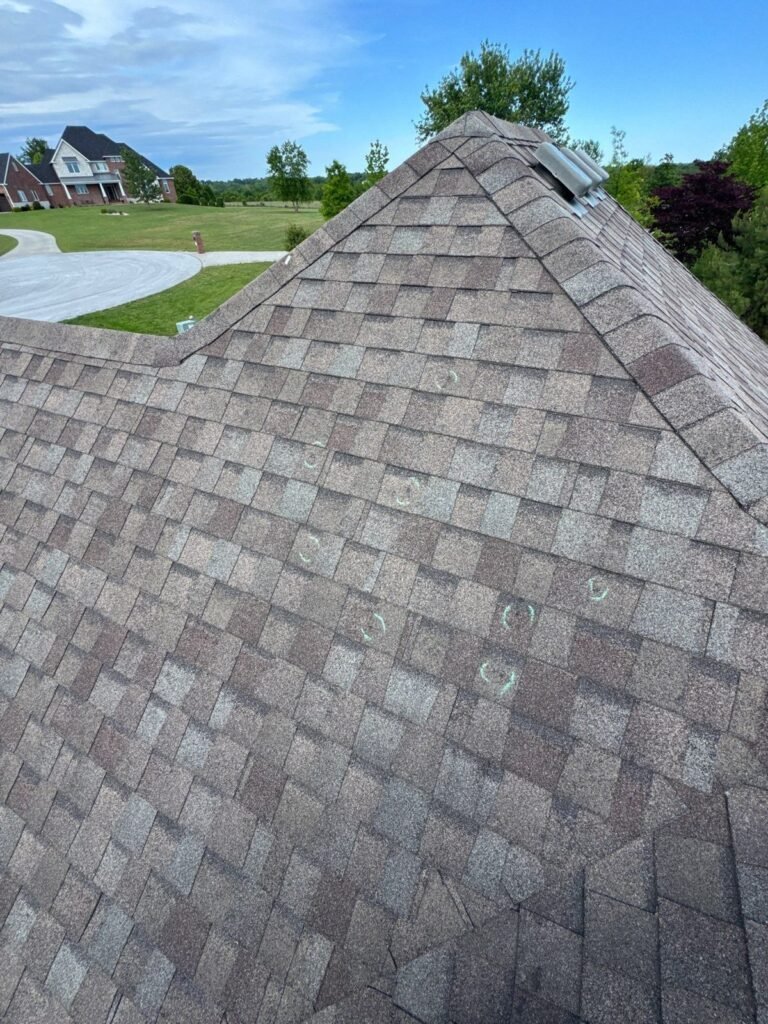
Adjusters mark off 10-by-10-foot sections on each roof slope and count qualifying hail impacts within each area. According to the National Roof Certification and Inspection Association, eight functional impacts per 100-square-foot test square is a commonly used industry threshold, though this number varies by insurer and policy. They’re looking for bruising, mat fractures, punctures, and concentrated granule displacement that matches a storm pattern rather than the gradual deterioration that comes with an aging roof.
Functional damage vs. cosmetic damage: why the distinction matters
Functional damage means hail compromised your roof’s ability to shed water: cracked shingle mats, exposed underlayment, fractured seams, or punctures that break the waterproofing layer. Cosmetic damage includes surface dents and discoloration that don’t breach the material, and many policies exclude it entirely. An adjuster who classifies all your damage as cosmetic can significantly reduce your payout, in some cases eliminating coverage for replacement claims entirely. This is why the specific language in your written inspection report matters as much as the physical condition of your roof.
What tips the decision from repair to full replacement
Isolated damage on one slope with intact shingles elsewhere typically produces a repair estimate. Widespread damage across multiple slopes, discontinued shingle products that can’t be matched, or compromised underlayment pushes the calculation toward full replacement. Roof age and overall condition factor into this too, especially on policies that pay only actual cash value.
What your policy actually says about hail coverage
Before you call your insurer, read your policy. Two homeowners with identical storm damage can receive very different payouts based on how their policies are structured. The sections below cover the most critical variables: your settlement method, your deductible structure, and any exclusions that limit what the carrier will pay.
ACV vs. RCV: which settlement method you have
Replacement cost value (RCV) policies pay what it costs to replace your roof with comparable materials, minus your deductible. Actual cash value (ACV) policies subtract depreciation for your roof’s age and condition before writing the initial check. Some RCV policies start with an ACV payment, then release the withheld depreciation once repairs are completed and documented.
| Feature | Actual cash value (ACV) | Replacement cost value (RCV) |
|---|---|---|
| Initial payment | Replacement cost minus depreciation and deductible | Often ACV first, then depreciation released after completion |
| Depreciation withheld | Yes, permanently | Yes, temporarily |
| Recoverable depreciation | Not available | Released after repairs are documented |
| Best for homeowner | Newer roofs with minimal depreciation | Most homeowners, especially with older roofs |
*Figures are a hypothetical illustration of standard ACV/RCV math and will vary based on your specific policy terms, roof condition, and deductible. Consult your policy or insurer for actual figures.
How Missouri’s percentage deductibles work
In Missouri, the most common structure is a separate wind and hail deductible calculated as a percentage of your dwelling coverage rather than a flat dollar amount, according to insurancequotes.com. The percentages most frequently offered are 1% and 2%, with some carriers ranging up to 5%. Know your specific number before you file; it changes the math on what your net recovery will actually be.
Cosmetic exclusions and roof-age limitations
Some policies include explicit cosmetic-damage exclusions that remove coverage for appearance-only damage. Others have endorsements that cap payments on older roofs regardless of the hail event. These are legal policy terms, and if yours apply, your roofing contractor needs to document and argue functional damage clearly in their written inspection report.
How to document hail damage the way insurers expect
Strong documentation prevents an insurer from attributing your damage to aging, prior storms, or deferred maintenance. Your goal is a paper trail that connects the hail event directly to the specific defects on your roof.
Photos and video that hold up to adjuster scrutiny
Photograph every roof slope from the ground, then capture close-ups of individual impact sites with a ruler or coin for scale. Photograph collateral damage on gutters, downspouts, window screens, air-conditioning fins, and siding; these items corroborate that the storm was severe enough to damage the roof, not just age it. Record a narrated video walkthrough of each damaged area and keep original files with timestamps and location metadata intact.
Weather records and written corroboration
Pull a weather report from the National Weather Service confirming hail size and storm track at your address on the storm date. Matching damage on neighboring properties, local news coverage, and neighbor statements all support your account if the insurer disputes whether a qualifying storm occurred. Document your roof’s pre-storm condition with any prior inspection reports, maintenance records, or dated photos you have on file.
The inspection report as your anchor document
A detailed written report from a licensed roofing contractor is your single strongest piece of documentation. It should identify each damaged area by slope, describe the type and cause of each defect, include test-square results with supporting photographs, and state clearly whether the damage is hail-related and whether repair or replacement is warranted. When the insurer’s scope doesn’t match reality, this report is what you present to challenge it.
Why do hail damage roof insurance claims get denied or underpaid?
Insurance companies reduce or deny hail claims for predictable reasons. Knowing those reasons in advance lets you counter them before they become a problem.
Pre-existing damage and wear-and-tear arguments
The most common underpayment tactic is attributing granule loss, cracked shingles, and surface deterioration to aging rather than hail. Proving your roof’s pre-storm condition with maintenance records, dated photos, or a prior inspection report is the most direct way to address this argument. The insurer has to demonstrate that damage predates the storm, not simply assert it.
Late reporting and failure to mitigate
Most policies require prompt notice after a covered loss. Delays give insurers grounds to argue that additional damage resulted from neglect rather than the original hail event. If your roof is leaking after a storm, place tarps immediately, keep every receipt, and report the claim within your policy’s specified timeframe. Document every call and piece of correspondence with your insurer from the start.
Comparing the insurer’s estimate line by line
When the adjuster’s written estimate arrives, compare it against your contractor’s estimate item by item. Check for discrepancies in:
- Measurements and material specifications
- Flashing and ventilation components
- Code-required upgrades
- Permit fees and disposal costs
Insurers routinely omit code-compliance work or undervalue labor in their initial estimates. Ask the insurer in writing to identify the exact policy provision supporting every item they excluded or depreciated.
Filing a hail damage roof insurance claim: when you need someone who knows how the other side thinks
Most homeowners enter a hail claim trusting the process to work fairly. When the damage is significant or the adjuster’s estimate falls well short of your contractor’s scope, you need more than a standard roofer.
What Bold Roofing’s former adjusters bring to your claim
Bold Roofing has former insurance adjusters on staff. They know the criteria adjusters use, the language that triggers cosmetic-only classifications, and the documentation gaps that invite lowball offers. When they inspect your roof after a hailstorm, they build the inspection report with the structure and detail an adjuster expects to see. That difference can be the margin between a fair settlement and one you have to fight.
How this expertise differs from a public adjuster
A licensed public adjuster is legally authorized to represent you in preparing and negotiating your claim, and they typically charge a percentage of your settlement. A roofing contractor with former-adjuster expertise provides accurate scope documentation and insight into how the carrier’s estimate was assembled, as part of the repair process. Bold Roofing provides free roof inspections.
When to escalate further
If the insurer’s estimate and your contractor’s estimate are far apart, request a reinspection in writing and have your contractor present. If the insurer denies coverage or refuses to adjust after additional documentation is submitted, a licensed public adjuster or property-claims attorney may be the appropriate next step. Don’t sign any assignment-of-benefits agreement or contingency contract without reading the full terms first.
The bottom line on getting what your hail damage roof insurance claim is worth
A fair payout on a hail claim doesn’t happen by default. It comes from documenting the damage thoroughly, understanding how your policy is structured, and pushing back with evidence when the adjuster’s scope doesn’t match what’s on your roof. Homeowners who get shortchanged are almost always the ones who trusted the process without verifying the details.
If your roof took a hit and you’re not sure what your claim is really worth, reach out to our team at Bold Roofing for a free inspection. A roof that’s fully restored and a settlement that actually covers it, that’s the standard. Contact us today to make sure yours meets it.
Frequently Asked Questions
How long do we have to file a claim after a hail storm?
You must report the loss promptly and within the timeframe specified by your policy. Delays give insurers grounds to reduce or deny coverage, so document any mitigation actions and all communications with the carrier as soon as possible.
Can we make temporary repairs before the adjuster inspects the roof?
Yes, make emergency mitigation such as placing tarps if the roof is leaking, and keep every receipt. Document those repairs and report the claim promptly so the insurer cannot argue that additional damage resulted from neglect.
How will my deductible affect the payout on a hail claim?
Your deductible can substantially change your net recovery because many Missouri policies use a wind and hail deductible calculated as a percentage of your dwelling coverage. Know your specific percentage (commonly 1% or 2%, and sometimes up to 5%) before you file, because it directly reduces the amount the insurer will pay.
Are photos and videos enough, or do we need a contractor’s written inspection report?
Photos and video are essential, but a detailed written inspection report from a licensed roofing contractor is your single strongest piece of documentation. That report should identify damaged areas, include test-square results with photos, state whether damage is hail-related, and recommend repair or replacement so you can effectively challenge an insurer’s scope.